
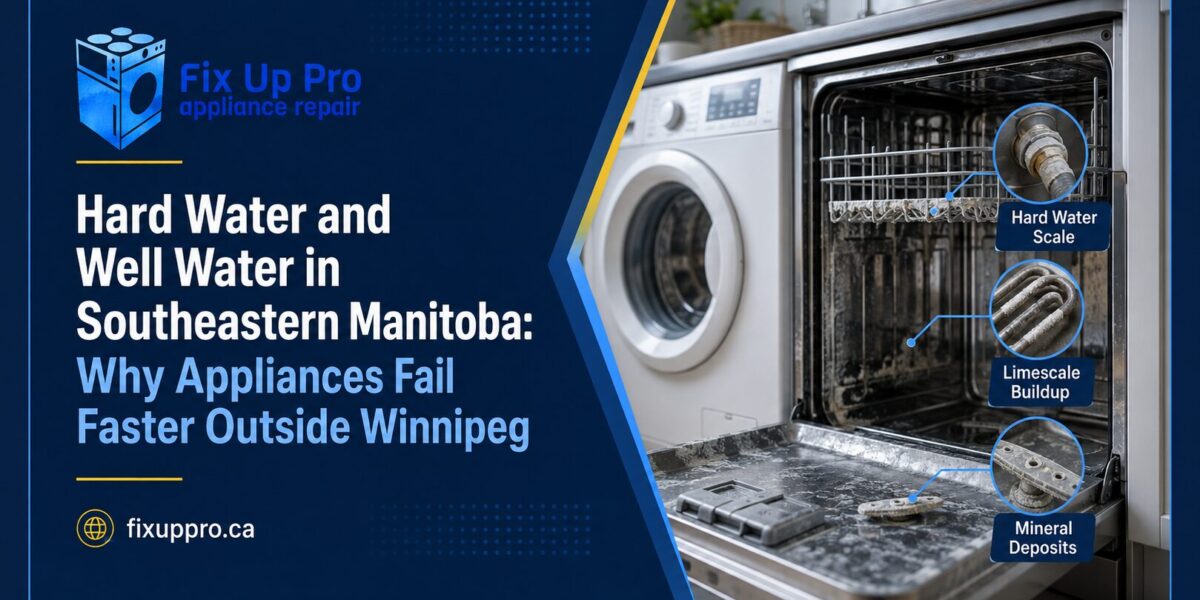
If your dishwasher, washer or fridge seems to wear out faster at your place in Landmark or Ste Anne than it did when you lived in the city, your water is very likely the reason. Winnipeg’s municipal supply is moderately soft. Private wells across southeastern Manitoba draw from limestone and dolostone bedrock, and that water is often several times harder — hard enough to shorten the working life of every water-fed appliance in the house.
This guide explains the actual difference between the two water sources, what mineral scale does inside each appliance, and how to tell a water problem apart from a failed part.
Winnipeg city water vs. private well water: the numbers
Winnipeg’s treated water averages roughly 82 mg/L of total hardness (about 5 grains per gallon), which puts it near the boundary between soft and moderately hard. Private wells on the regional carbonate aquifer commonly test in the “very hard” range and higher. The gap between the two is the entire reason appliances behave differently a twenty-minute drive apart.
Winnipeg draws from Shoal Lake, a surface source on the Manitoba–Ontario border, and the city’s own annual water report publishes the hardness figure each year. Rural properties outside the city’s distribution system draw from groundwater that has spent a long time moving through Ordovician limestone and dolostone — the rock dissolves, and the calcium and magnesium end up in your plumbing.
| Hardness class | mg/L as CaCO₃ | Grains per gallon | What it means for appliances |
|---|---|---|---|
| Soft | 0–60 | 0–3.5 | No meaningful scale; normal service life |
| Moderately hard | 61–120 | 3.5–7 | Light scale over years; Winnipeg city water sits here |
| Hard | 121–180 | 7–10.5 | Visible film, slower heating, cloudy glassware |
| Very hard | Over 180 | Over 10.5 | Active, ongoing damage; many rural wells sit here or above |
Hardness is not a health issue — calcium and magnesium are harmless to drink. It is a mechanical issue. Every litre of hard water that gets heated leaves a small mineral deposit behind, and appliances heat water thousands of times a year.
What scale actually does inside each appliance
Scale forms fastest wherever water is heated or forced through a narrow opening. That means heating elements, spray arms, inlet valves, pumps and water lines take the damage first — which is why hard-water failures cluster around the same handful of parts.
Dishwashers
The heating element scales over and takes longer to bring water to temperature, so the detergent never fully activates and dishes come out gritty or filmed. The spray arm holes narrow, which drops water pressure and coverage. The inlet valve and the drying element are the next to go. Homeowners usually blame the detergent for months before calling anyone.
Washing machines
Scale builds on the heater (in models that heat their own water), inside the drum and around the inlet valve screens. Hard water also inactivates a portion of your detergent, so people compensate by using more — and the extra detergent that does not rinse out leaves residue in the drum and the pump filter, which feeds odour and drainage problems.
Refrigerators with ice and water dispensers
This is the failure we see most often on rural service calls. Water filters clog months ahead of schedule. The ice maker’s fill tube narrows and eventually freezes shut. Solenoid valves stick open or closed. Ice comes out hollow, undersized or with a chalky taste.
Anything with a water inlet valve
Inlet valves are small, spring-loaded and precise. Mineral deposits on the seat stop them from closing fully, which produces a slow drip that gets blamed on a hose or a door seal for a long time before anyone checks the valve.
What we see on service calls outside the city
Working across Steinbach, Landmark, Lorette, Oak Bank and Ste Anne, our technicians see a distinct pattern that does not show up on the same appliances inside Winnipeg.
- Same fault, different clock. A dishwasher heating element that would be fine at year eight in a city home shows heavy scale at year four on an untreated well.
- The softener is there but not working. A large share of rural homes already have a softener. Plenty of them have run out of salt, jammed on the regeneration cycle, or were sized for a smaller household years ago. The homeowner assumes they are protected.
- Iron on top of hardness. Many southeastern Manitoba wells carry iron and manganese as well. That shows up as orange-brown staining in the dishwasher tub and on laundry, and a softener alone will not handle it.
- Repeat visits on the same part. When a valve or element is replaced without addressing the water, the replacement part goes the same way on the same schedule.
The practical takeaway: on a well, appliance maintenance and water treatment are the same job. Treating them separately is what turns a $200 part into a recurring expense.
Signs your water is damaging your appliances
Hard-water damage announces itself well before an appliance fails outright. The tell is that the symptoms appear across several appliances at once rather than in one machine.
- White or chalky film on glassware and inside the dishwasher tub
- Laundry coming out stiff, dull or greyish despite normal detergent
- Dishwasher or washer cycles taking noticeably longer than they used to
- Reduced water pressure at the fridge dispenser, or smaller and hollow ice cubes
- Fridge water filters needing replacement well ahead of the rated interval
- Crusty white buildup around inlet hoses, spray arms and faucet aerators
- Soap and detergent that lather poorly and need larger doses to work
What actually helps
Softening the water at the source is the only measure that addresses the cause; everything else manages the symptoms. If a whole-home system is not on the table right now, the maintenance steps below still meaningfully slow the damage.
- Get a real water test first. Test for hardness, iron, manganese and nitrates, not hardness alone. Well owners should retest annually — water chemistry shifts with the water table.
- Check that the softener is actually regenerating. Salt level, brine tank condition and regeneration cycle, at least seasonally. A softener that stopped working three months ago looks identical to one that is working.
- Use a rinse aid in the dishwasher year-round. On hard water it is not optional. It stops mineral film from bonding to dishes and to the tub.
- Run a descaling cycle on a schedule. Dishwasher and washer, roughly every one to three months depending on hardness, using a citric-acid or purpose-made descaler rather than improvised mixtures.
- Clean filters and screens more often than the manual says. Dishwasher filter, washer inlet screens and fridge water filter — manufacturer intervals assume municipal water.
- Adjust detergent to your water, not to the box. Hard water needs more; softened water needs noticeably less, and overdosing softened water creates its own residue problems.
Water problem or broken part?
The distinction matters because scale-related symptoms come on gradually and affect more than one appliance, while a failed component usually fails suddenly and stays confined to one machine. If the change was abrupt, water treatment is not your answer.
Call a technician rather than reaching for a descaler when you see any of the following: water pooling on the floor, an error code on the display, a burning or electrical smell, an appliance that trips the breaker, or a machine that will not start a cycle at all. Those are component failures, and while hard water may have contributed, descaling will not fix them.
If your symptoms match the scale pattern instead, the sequence is straightforward: test the water, correct the treatment, descale the appliances, then replace whatever parts have already been damaged. Doing it in the other order means paying for the same part twice.
Frequently asked questions
Is Winnipeg tap water hard?
Winnipeg’s treated water averages around 82 mg/L of total hardness, roughly 5 grains per gallon. That is moderately hard — soft enough that most city homes never need a softener for appliance protection.
Why is my well water so much harder than city water?
Southeastern Manitoba’s groundwater sits in a carbonate aquifer of limestone and dolostone. Water dissolves calcium and magnesium out of that rock as it moves through, so it arrives at your tap loaded with the minerals that form scale. Winnipeg’s supply comes from a surface lake that never passes through those formations.
Does hard water actually shorten appliance lifespan?
Yes, measurably. Scale insulates heating elements so they run longer and hotter to reach the same temperature, restricts flow through valves and spray arms, and accelerates wear on pumps and seals. The effect is cumulative rather than sudden.
Will a water softener fix appliances that are already damaged?
No. A softener stops new scale from forming, but existing deposits stay put. Descale the appliances after installing treatment, and replace parts that have already scaled over — the softener protects the new ones.
Can I use vinegar to descale my dishwasher or washer?
Vinegar works on light film, but it is acidic enough to degrade rubber seals and gaskets over repeated use. A citric-acid or purpose-made appliance descaler removes heavier scale more effectively without the same risk to seals.
How often should well owners test their water?
Once a year at minimum, and again any time you notice a change in taste, smell, colour or appliance performance. Groundwater chemistry is not static, and a test from five years ago no longer describes what is coming out of your tap.